Government designates first tranche of critical infrastructure projects
The Government has designated nine major transport, water and energy projects as critical infrastructure under the Critical Infrastructure Act 2026, giving them priority status across the public sector in a move aimed at accelerating the delivery of nationally significant infrastructure.
Approved on the recommendation of Minister for Public Expenditure, Infrastructure, Public Service Reform and Digitalisation, Jack Chambers TD, the projects are the first to be designated under the new legislation, which creates a legal obligation for public bodies to prioritise decision-making and approvals for infrastructure deemed critical to the State.
Under the Act, public bodies involved in these projects are required to prioritise licences, consents, planning conditions and other statutory approvals, allocate the necessary administrative and technical resources, and, where possible, run approval processes concurrently rather than sequentially.
While the legislation does not alter planning law or environmental safeguards, it is intended to address one of the construction sector’s long-standing challenges—the time required to progress major infrastructure projects through multiple regulatory and consent processes.
Commenting on the announcement, Minister Chambers said the designation demonstrates the Government’s determination to “break through inertia, slash project timelines and accelerate the delivery of the infrastructure that our people, communities and businesses urgently need.”
He said the projects are of strategic national importance and will strengthen Ireland’s transport, water and energy networks while supporting housing delivery, economic competitiveness and the transition to a low-carbon economy.
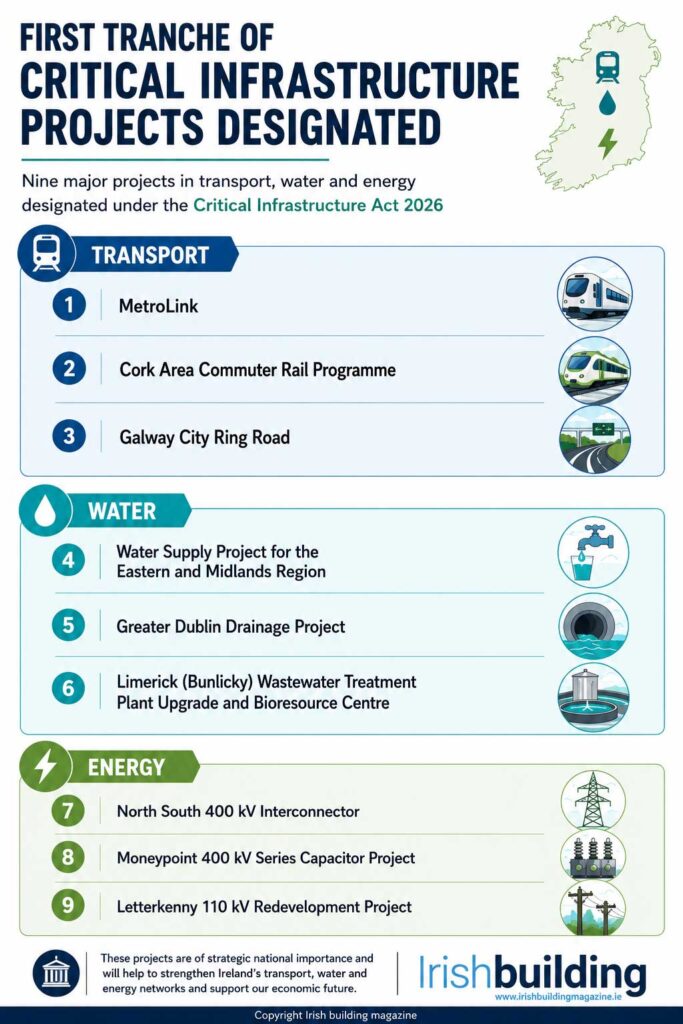 Among the flagship schemes, MetroLink will provide a high-capacity rail connection between Swords, Dublin Airport and Dublin city centre, while the Cork Area Commuter Rail Programme will expand rail services across the Cork metropolitan area. The Galway City Ring Road is expected to improve regional connectivity and reduce congestion.
Within the water sector, the Water Supply Project for the Eastern and Midlands Region will enhance long-term water security, while the Greater Dublin Drainage Project and the Bunlicky Wastewater Treatment Plant upgrade will increase wastewater capacity to accommodate future population growth and economic development. The three designated energy projects are intended to strengthen Ireland’s electricity transmission network, improve system resilience and support the country’s transition to a lower-carbon energy system.
For Ireland’s construction industry, the announcement represents more than the designation of nine individual projects. It signals a shift in how strategically important infrastructure will move through the public approvals system. Major capital projects typically require numerous licences, permissions and regulatory consents from multiple agencies before construction can commence. By requiring public bodies to prioritise designated projects and coordinate approvals wherever possible, the Government is seeking to reduce unnecessary delays while maintaining existing statutory and environmental obligations.
The designation of transport, water and energy infrastructure also reflects the reality that these sectors underpin many of Ireland’s wider ambitions, including housing delivery, industrial investment and regional economic development. Greater certainty around approval timelines should, in turn, provide increased confidence for clients, contractors, consultants and the wider supply chain as projects move towards procurement and construction.
Further designation orders are expected to be brought forward throughout the year as the Government continues to implement its Accelerating Infrastructure Action Plan. For the industry, the success of the new legislation will ultimately be measured not by the number of projects designated, but by whether it delivers meaningful reductions in approval timelines and enables critical infrastructure to reach construction more quickly.
Follow Irish building magazine on LinkedIn for the latest news and updates.