

The Architects’ Guide to ICMS: Who Really Controls the Cost? Why ICMS Belongs in the Studio
In the latest instalment of her series on the International Cost Management Standard (ICMS), 5D BIM Quantity Surveyor Mary Flynn continues with her theme on ICMS for architects, exploring further how architects can engage with and implement ICMS throughout the design process. Mary is an ICMS Trustee for the European Council of Construction Economists (CEEC).
In the previous article, Mary examined the current beliefs held by architects and how they are changing, explained ICMS from the perspective of architects, discussed the seven different ways RIAI supports ICMS 3 and concluded with an ICMS 3 public-sector checklist specifically for architects. In this article, Mary looks at how ICMS and SEAI connect in practice, how ICMS interacts with the Climate Action Plan (CAP25), how ICMS interacts with Design for Performance (DfP), and how DfP supports ICMS 3 in Irish public-sector projects.
How do ICMS and SEAI (Sustainable Energy Authority of Ireland) connect in practice?
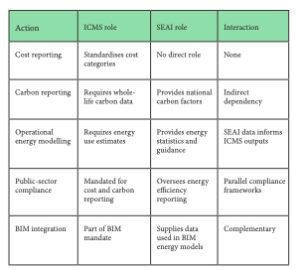
ICMS and SEAI do not directly interact as formally linked systems; however, they do intersect in practice because, in a nutshell, ICMS is how you structure and report costs plus carbon, while SEAI is where you get the authoritative energy and carbon data.
ICMS requires whole-life carbon and energy-related reporting. ICMS 3 mandates consistent reporting of construction costs and carbon impacts (including operational and maintenance energy use) across the asset lifecycle. This means any organisation using ICMS must quantify operational energy performance and carbon factors, hence the connection.
SEAI provides the notional data and guidance needed for those calculations. SEAI publishes Ireland’s official energy statistics, carbon factors and energy-efficiency guidance, which are routinely used by public bodies and consultants when modelling operational energy and carbon. These include national energy-consumption data, the carbon intensity of electricity and fuels, retrofit and heat-pump performance guidance, public-sector energy-efficiency reporting frameworks and much more. ICMS has been mandated by the Irish Government for cost and carbon reporting on public-sector projects since January 2024, while SEAI oversees public-sector energy-efficiency reporting and supports Ireland’s climate-action targets. Both ICMS and SEAI support Ireland’s Building Information Management (BIM) and climate and sustainability mandates.
You must always use SEAI factors for Ireland when reporting public-sector energy emissions, preparing corporate ESG or CSRD reports, completing ICMS whole-life carbon assessments and using TII’s Carbon Tool for infrastructure projects.
How do ICMS and the Climate Action Plan (CAP25) interact?
Put simply, the Climate Action Plan (CAP25) asks: how can we reduce carbon emissions from construction? ICMS 3 answers by measuring carbon and cost together throughout the whole lifecycle, allowing better-informed decisions that balance affordability, value and sustainability. From the architect’s perspective, ICMS 3 provides the measurement framework that enables comparison and reporting on the costs and carbon impacts of design decisions that deliver these reductions, while Ireland’s Climate Action Plan (CAP25) provides the policy objectives and carbon-reduction targets. Together, they influence how buildings are designed, specified, costed and reported throughout their lifecycle. CAP25 is the current Irish Government roadmap (published on 15 April 2025) for delivering Ireland’s legally binding carbon budgets and achieving a 51% reduction in greenhouse-gas emissions by 2030. https://www.gov.ie/en/publication/adf71-climate-action-plan-2025/
The built environment is responsible for around 40% of global carbon emissions; therefore, it is crucial that sustainable practices are adopted to achieve net-zero ambitions. Every day, we increasingly witness in the media major disasters, from fires and floods to landslides, brought about by accelerating climate change.
CAP25 has four main objectives:
- Reduce greenhouse gas emissions by 51% by 2030 compared to 2018 levels.
- Achieve climate neutrality by 2050.
- Deliver the legally binding carbon budgets and sectoral emissions ceilings adopted by the Irish Government.
- Build a climate-resilient, biodiversity-rich and environmentally sustainable economy.
ICMS 3 is a global standard for classifying and reporting carbon data alongside cost data. It has been mandated by the Irish Government since 1 January 2024, as well as by the Society of Chartered Surveyors Ireland (SCSI) for its members.
ICMS requires reporting across the full asset lifecycle, otherwise known as Whole-Life Carbon Assessment (WLCA), or simply think of it as ‘whole-life thinking’, where carbon reporting is integrated into each lifecycle stage: Acquisition, Construction, Renewal, Operation, Maintenance and End of Life.
For architects, CAP25 means that early design decisions become carbon decisions. The Irish architect is evolving from being solely a designer of buildings to being a designer of climate-resilient, low-carbon assets.
Architects involved in Irish public-sector projects, such as schools, social housing, healthcare buildings and public infrastructure, are expected to demonstrate carbon-reduction measures, sustainable material choices and energy efficiency, as well as compliance with national climate objectives. ICMS 3 provides the recognised structure for documenting and presenting these carbon outcomes.
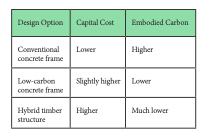
For example, an architect would need to consider optioneering in conjunction with the quantity surveyor to establish the best design solution for a building frame, as shown.
CAP25 Performance to Date: The Need for ICMS
The Irish construction sector reports good progress in retrofit delivery, where we have exceeded the annual target; in building-energy standards, through the use of NZEB standards and the continued tightening of Part L requirements; and in reducing industrial emissions from material production, such as cement. However, the sector is falling behind in other areas: building emissions increased by 5.6% in 2024, and the heat-pump roll-out is significantly behind schedule.
Embodied-carbon reduction is at an early stage, with circular-economy implementation only beginning to develop. Industry-wide measurement using methodologies such as ICMS 3, Life Cycle Assessment (LCA) and Environmental Product Declarations (EPDs) is growing but is not yet universally embedded across projects. CAP25 and the Irish Green Building Council (IGBC) increasingly recognise that embodied carbon (steel, aluminium, transport, construction processes, etc.) remains a major challenge.
The Climate Change Advisory Council and the Environmental Protection Agency (EPA) both indicate that current trajectories for buildings are likely to miss sectoral emissions ceilings unless retrofit rates, heat-pump adoption and embodied-carbon reduction measures accelerate substantially over the next four years. For architects, working in collaboration with quantity surveyors and the wider design team, the next major change is the widespread use of ICMS 3 carbon measurement, whole-life carbon reporting and embodied-carbon targets within public (mandatory) and private (desirable) procurement, as these are the essential tools for closing the CAP25 delivery gap.
The Five Most Important CAP25 Actions for Architects Today
- Design beyond minimum Part L compliance: Building Regulations, TGD Part L (2022 Edition), Conservation of Fuel and Energy – Dwellings, fabric performance, etc.
- Eliminate fossil-fuel heating systems from all new projects and integrate renewable-energy infrastructure from the concept stage, such as by maximising roof suitability for PV and solar technologies.
- Undertake whole-life carbon assessments using ICMS 3 and carry out optioneering to identify the best carbon and cost solution.
- Design for climate resilience through green roofs, nature-based solutions and biodiversity, referring to the All-Ireland Pollinator Plan 2021–2025, which lists 186 actions across six strategic objectives. Reference should also be made to the National Biodiversity Action Plan 2023–2030 (NBAP), which aims to deliver the transformative changes required to halt biodiversity loss and restore nature across Ireland, ensuring that government, public bodies, businesses, communities and citizens all contribute to biodiversity conservation.
- Design for a circular economy through material reuse, disassembly, waste prevention, adaptability, durability and so on. Refer to the Whole of Government Circular Economy Strategy (Ireland) 2026–2028.
It is vitally important that buildings are future-proofed, taking into consideration climate adaptation and resilience so that they can respond to flooding, extreme rainfall, overheating, etc., as well as circular-economy and resource-efficiency requirements. Failure to future-proof buildings could result in stranded assets that become obsolete within 10 to 15 years and require major retrofit expenditure.
Architects can demonstrate alignment with the Climate Action and Low Carbon Development (Amendment) Act 2021 and Climate Action Plan 2025 by applying ICMS 3 to measure and report whole-life cost, embodied carbon and operational carbon at each stage of project development, thereby supporting transparent evidence-based decisions that advance Ireland’s decarbonisation objectives.
CAP25: What Is Required Today Versus What Is Coming Down the Track
The Irish Government takes the Climate Action Plan so seriously that CAP25 is currently being updated to CAP26. The Department of Climate, Energy and the Environment launched a public consultation on the next update to the Climate Action Plan on 15 June 2026, stating that this update is planned for publication later in 2026. The consultation also notes that Ireland is entering the Second Carbon Budget Period (2026 to 2030), when additional measures will be required to remain on the pathway to the 2030 and 2050 climate targets.
The 2026 review is expected to assess progress against carbon budgets, reflect updated EPA emissions projections, introduce new measures and actions, accelerate delivery in sectors where emissions reductions are behind target, and support the Second Carbon Budget Period (2026 to 2030). Architects and other designers can expect greater emphasis on the objectives of CAP25 and on measurable outcomes, more robust energy-performance evidence, and increased scrutiny of sustainability commitments. The final plan has not yet been published, so any further mandatory requirements, as well as possible taxes and levies, are as yet unknown.
How Does ICMS Interact with Design for Performance (DfP)?
Design for Performance is a building-design process that aims to ensure a building achieves verified real-world energy and carbon performance once occupied, rather than merely theoretical compliance at the design stage. It closes the gap between predicted and actual performance. In Ireland, the concept of Design for Performance was formally introduced as a national initiative in 2023, when the Irish Green Building Council (IGBC) and the Royal Institute of the Architects of Ireland (RIAI) launched a joint SEAI-funded project to develop an Irish Design for Performance framework.
In May 2025, the completed Design for Performance Framework was officially launched nationally by RIAI and IGBC, providing detailed guidance, trackers and performance indicators aligned with the RIAI 2030 Climate Challenge and the revised Energy Performance of Buildings Directive (EPBD) requirements for industry use.
The RIAI 2030 Climate Challenge is a great piece of work, and it aligns closely with Ireland’s Climate Action Targets (as well as Whole-Life Carbon Assessment), but they are not the same thing. The key difference is that the former is a voluntary, profession-led framework for architects and design teams that encourages the wider construction industry to achieve net-zero whole-life carbon for new and retrofitted buildings by 2030, while the latter is a national policy and legal framework that applies across the entire economy and is supported by legislation, regulations, carbon budgets and annual Climate Action Plans. The biggest difference for architects is that the Climate Action Plan tells them what they must achieve and defines the national destination, whereas the RIAI 2030 Climate Challenge provides a practical framework for how architects can help achieve it through individual projects; it defines a route map for architects and project teams to get there at building level. Believe it or not, the RIAI 2030 Climate Challenge is more ambitious than the current minimum regulations. For public-sector projects in Ireland, the approach is to view the RIAI 2030 Climate Challenge, the Climate Action Plan CAP25 and, when published, CAP26, Whole-Life Carbon Assessment, ICMS 3 and Design for Performance (DfP) as complementary parts of a project-sustainability framework: ‘the whole is greater than the sum of its parts’.
Quantity Surveyors and Architects Can Work Together Collaboratively and Learn from Each Other
The Irish version of DfP focuses on four key metrics: operational energy, embodied carbon, water use and indoor environmental quality.
The RIAI 2030 Climate Challenge addresses whole-life carbon, not just operational energy. It includes embodied-carbon targets and water efficiency, as well as health-and-wellbeing metrics, while encouraging designers to move beyond compliance towards verified performance.
From the quantity surveyor’s perspective, the Climate Action Plan creates the policy backdrop, while the RIAI 2030 Challenge directly influences:
- ICMS 3 carbon reporting
- Whole Life Carbon Assessment (WLCA)
- Material selection
- Circular economy strategies
- Design for Performance (DfP)
- Biodiversity and sustainability requirements
- ESG reporting and green finance criteria
Going forward, QSs need to become more informed about circular-economy strategies, biodiversity, ESG reporting, green procurement and so on, as this is where the RIAI 2030 Climate Challenge, CAP25 and future Climate Action Plans are heading.
Conclusion
Architects primarily—as the main designers, but not exclusively, since designers also include any professional with a design input, such as structural, civil and M&E engineers—make many of the critical choices that determine a project’s cost, value, carbon impact and long-term performance. The International Cost Management Standard (ICMS) offers architects a common language for understanding and communicating these consequences from the earliest concept stages. ICMS empowers design teams to engage more confidently with cost, demonstrate the value of design decisions, and collaborate more effectively with clients and consultants.
Architects need to stop letting quantity surveyors have all the fun and claim some share of ICMS for themselves, for if the greatest opportunities to influence cost occur in the studio, then perhaps that is exactly where ICMS belongs. As a practising quantity surveyor, I must acknowledge that ICMS is far from being a tool reserved for quantity surveyors; ownership should reside predominantly, or at least partially, with designers, since they are the key players influencing between 80% and 90% of whole-life carbon through their designs. Architects need to understand ICMS because what you design matters. Remember: ‘The blueprint dictates the bills—both the Bill of Quantities and the Bill of Carbon.’ Design is the real data, and design is ICMS detail.
Architects recognise the power of the pencil because they dictate the ICMS outcomes. In the next edition, we will discuss further the importance of ICMS to architects.
Follow Irish building magazine on LinkedIn for the latest news and updates.