
ICMS at 10: Setting the gold standard for collaboration
In part 2 of her series on ICMS (International Cost Management Standard), 5D BIM quantity surveyor and Irish building contributor, Mary Flynn discusses the extent to which it is a standard for collaboration in the built environment, and reports on the coalition’s recent conference to mark its 10-year anniversary.
September 24 2025, saw ICMS mark a decade of progress back where it all began – in the historic International Monetary Fund HQ building in Washington DC.
Formed on June 17, 2015, the coalition is a non-governmental, not-for-profit professional organisation, and that day heralded the start of one of the greatest collaborations in the history of the built environment. Over the past decade ICMS has grown from its original 49 members to over 80, with adoption continuing to grow right across the globe.
It has developed into a truly global coalition standard, with ICMS (3rd edition): Global Consistency in Presenting Construction Life Cycle Costs and Carbon Emissions, along with the RICS Whole Life Carbon Assessment (WLCA) standard, now recognised as the leading taxonomy for life cycle costs and carbon emissions.
In its 10 years to date, the coalition has made significant progress via persistent collaboration between the trustees and the Standard Setting Committee (SSC). The first edition of ICMS in 2017 focused on capital costs, while the second – in 2019 – covered construction and other life cycle costs.
ICMS has always kept pace with the pressing global issues of the day and believes in being relevant; hence it produced its third edition in 2021. This ground-breaking publication recognised the urgency of reducing greenhouse gas emissions in line with global climate change concerns, integrating both cost and carbon management in the built environment.
Day One
The first day of the 10th anniversary celebration was intense and productive, with presentations on the state of ICMS across the globe. It opened with a warm, welcoming speech from David Dent, IMF World Bank representative, followed by a welcome from the chairman of the ICMS Board of Trustees, Philip Kehru (ISU), and the President of AACE International, Mark Zeirdan.
Ken Creighton, meanwhile, spoke on how ICMS was conceived, whilst Anil Sawhney (RICS) addressed how the SSC was formed. The SSC comprises experts from a wide range of professional organisations in the built environment from across the globe, and acts independently from the coalition members.
Sheila Lennon (AIQS) presented on the state of ICMS in the Americas. As CEEC (European Council of Construction Economists) ICMS trustee, I then had the honour of presenting a talk on ‘ICMS: The Irish Mandate: The Irish experience’. Matthieu Lamy (UNTEC) spoke about ICMS in Europe, whilst Ruya Fadason (NIQS) gave the Nigerian perspective, and Prof Chitra Weddikkara (CASTLE) addressed ICMS in Sri Lanka and Malaysia.
The afternoon sessions were both insightful and future-facing, concentrating mostly on the way forward for ICMS. There was an ICMS proposal for adoption into World Bank-funded infrastructure project contracts, and an emphasis on the need to look at AI and its effect on ICMS into the future.
Day Two
The second full-day hybrid conference, with AACE International, was hosted by K2 Consulting in the East-West conference room, Bethesda, Maryland.
Let me give you some background on AACE International; a non-profit professional association, it has been serving the total cost management community since 1956. Previously known as the American Association of Cost Engineering, it changed its name in 1992 to reflect its global membership. It now has over 8,000 members in some 100 countries. These include total cost management professionals such as those working in cost engineering, cost estimating, planning and scheduling, decision and risk management, project control, claims etc.
On November 16 this year Strata supported the launch of the AACE International Ireland section. This creates a valuable platform to support professionals in cost engineering (quantity surveying and similar disciplines) by providing industry-leading resources, standards and certifications for local professionals to connect, learn and collaborate within this global community. The focus will be on enhancing professional knowledge, championing digital innovation and creating networking opportunities for professionals across construction, infrastructure and technology through a host of virtual and in-person events. The inaugural Chair of the Ireland section is John Ryan.
The second day’s proceedings featured several presentations, kicked off with one from Tolis Chatzisymeon, who was involved in the creation of three ICMS standards and who discussed how he might standardise software for global usage – and what barriers would need to be overcome to do that.
The second presentation was on a recent RICS report on AI in construction, led by Anil Sawhney. This report gives a global snapshot of how surveying professionals across the built and natural environment are thinking about AI in construction, its potential, its barriers and how prepared they feel. Its findings cut through the hype, and paint a picture of the current state of AI in the sector.
For example, respondents report very limited AI adoption among construction organisations globally, with 45% reporting no AI implementation, 34% in early pilot phases, 12% making regular use of AI in specific processes, 1.5% using it across multiple processes and 1% with fully embedded use.
AI preparedness remains low across the construction sector. The findings indicate that nearly three quarters of companies have yet to move beyond initial discussions or have no capability or planning activity related to AI adoption. Some 29% state that they have neither capability nor plans in place. This suggests that although the sector is aware of the AI potential, it has not yet made the structural or cultural shifts required to implement it at scale.
Professionals believe that AI could improve most aspects of construction projects. Notably, the top-ranked project functions where AI is expected to have a high positive significance are:
- Progress monitoring and project scheduling (36%)
- Resource optimisation and reviewing contracts and project documents (30%)
- Risk management (29%)
- Cost management (25%)
Lack of skilled personnel is the most-cited barrier to AI adoption. The top three challenges are perceived to be: lack of skilled personnel (46%), integration with existing services (37%), and data quality and availability (30%).
Professionals expect AI to have the most significant impact on design optioneering (40%); there is remarkable global consensus on this. Next is skills training (13%), with AI having the potential to address workforce development challenges. After that it is areas such as regulatory compliance (11%), autonomous robotics (10%), predictive digital twins (10%), low-carbon and circular construction (8%) and safety and wellbeing (6%).
There is no global consensus among construction companies on how much to invest in AI. The largest single group reports no plans for AI investment (28%), whilst 25% plan moderate increases in AI expenditure. Meanwhile, 19% say their company plans to maintain current investment levels. Only 6% are planning a significant increase in AI expenditure, while 1% intend to decrease investment.
Overall, optimism is high, with 67% of quantity surveyors agreeing that AI will help them deliver greater value; yet 38% report concerns about the impact of AI on their role and 41% agree that they feel overwhelmed by how quickly technology is changing the surveying profession.
In summary, the findings reveal an industry at a key moment in its digital transformation journey, and show that while it knows it needs to accelerate AI adoption, this is subject to some major hurdles being managed and regulated.
Working together
The sister suite of ICMS, IPMS and ILMS is designed to be compatible with a wide range of other international standards, all working together for the common good. This suite comprises a number of international interrelated standards covering the built environment, all of which have universal principles and ethics at their core:
- IPMS – International Property Measurement Standards. ICMS defers to the IPMS for the measurement of areas, practice and reporting. IPMS focuses specifically on measuring all classes of buildings and their use for strategic decision-making.
- ILMS – International Land Measurement Standards. ILMS is a global principle-based standard for land assets and transactions encompassing due diligence to reduce risk and promote better land governance.
- IVS – International Valuation Standards. This is a globally recognised set of principles that provide a consistent, transparent and high-quality framework for professionals to value all types of assets. The consistent measurement provided by IPMS and ILMS helps to ensure the credibility of valuations by promoting a standard international approach to valuation under engagements, reporting and the use of various application methods under IVS.
- IFRS – International Financial Reporting Standards. ICMS, IPMS and ILMS all support the financial reporting system of IFRS. These are a common set of accounting rules used globally to ensure that financial statements are transparent, comparable and credible across countries. IFRS is used in over 140 jurisdictions to provide a common language for financial reporting and informed decision making.
- IES – International Ethical Standards. These are foundational moral principles and values intended to guide behaviour and decision-making on a worldwide scale, across various professions, industries and governments. The IES comprises 130 organisations working to promote a universal set of ethical principles for land, property and construction.
These international standards are also compatible with the ISO Standards:
- ISO 19650 Series, commonly referred to by the acronym BIM (Building Information Modelling) though the correct title should be IM (Information Management) according to the ISO 19650 Series. The Irish Government mandated both the use of BIM and ICMS as of January 1, 2024 to work together to provide standardised real-time data for all public works in the built environment.
- ISO 15686-5:2017 (Life-cycle costing). ICMS is compatible with this standard, which deals with the life-cycle costing for buildings and constructed assets.
- ISO – The International Organisation for Standardisation maintains a Code of Ethics and Conduct for persons involved in its global standardisation activities, emphasising universal principles of integrity, impartiality, beneficence and nonmaleficence, and legal compliance.
- National Standards: the core principle of these international standards is to provide a high-level framework, enabling cross-boundary comparisons of various jurisdictions already using local practices.
In conclusion, ICMS is set to become the accepted global standard for consistency in cost reporting and the integration of carbon and sustainability. These goals will be achieved through improved collaboration, with support in the form of policy and regulation, and will be marked by both credibility and transparency.
An ICMS trustee for the CEEC, Mary is also part of the Society of Chartered Surveyors Ireland’s ICMS working group, for whom she has co-authored several explanatory publications.
In the next part of this series, we will examine how ICMS enhances the role of other construction disciplines and how it truly embraces the language of collaboration for the built and natural environment.
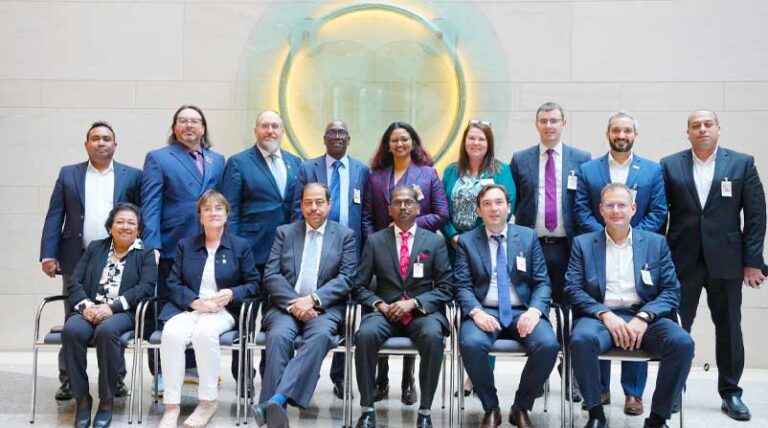
Pictured above:
Back row: Ravindra Maurya, David Dooks, Brian McBurney, Ruya Fadason, Sinimol Noushad, Sheila Lennon, Kevin Brady, Mark Zeidan, Ahalad Aziza. Front row: Chitra Weddikkara, Mary Flynn, Varughese Mathew, Anil Sawhney, Matthieu Lamy, Tolis Chatzisymeon.
This article first appeared in Irish building magazine, click here to view.
Follow Irish building magazine on LinkedIn for the latest news and updates.